The most efficient way to deliver high fidelity personalization in your daily email, and drive over 11x return on spend (works seamlessly with your existing email service provider).
Infinitely expand your brands photography with Curator™ AI. Generate new product photography that’s indistinguishable from the originals, and combines multiple products together.
Create, manage, deploy, and target an unlimited number of personalized messages. Deliver any of the messages from your pool through a single image URL and link embedded within email, SMS, mobile, or on your website.
Zembula connects with any enterprise data source. If you don’t see a specific data source here or have a custom data source, we will always connect it for free.
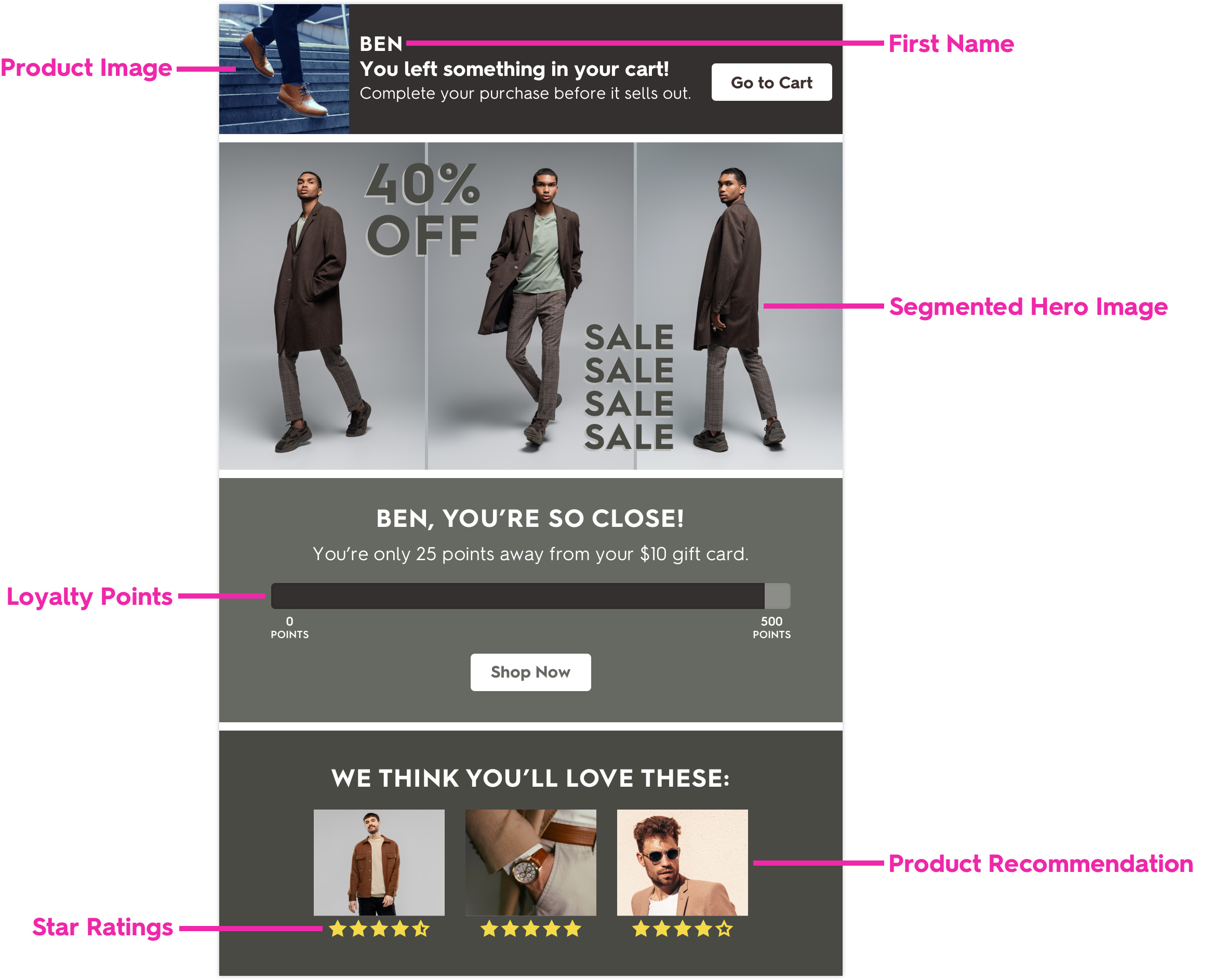
The most efficient way to deliver high fidelity personalization in your daily email, and drive over 11x return on spend (works seamlessly with your existing email service provider).
Infinitely expand your brands photography with Curator™ AI. Generate new product photography that’s indistinguishable from the originals, and combines multiple products together.
Create, manage, deploy, and target an unlimited number of personalized messages. Deliver any of the messages from your pool through a single image URL and link embedded within email, SMS, mobile, or on your website.
Integrations
Connect with 100+ integrations
Zembula connects with any enterprise data source. If you don’t see a specific data source here or have a custom data source, we will always connect it for free.
There are many ways to determine your marketing campaigns’ success. Revenue and conversions are two. But what about really digging into the numbers? What can you learn from them to help you optimize performance and get more out of your campaigns?
That’s where return on ad spend (ROAS) can be a marketer’s best friend. In a world where data is increasingly important, yet it’s often more challenging to find the signal in the noise, a key performance indicator like ROAS can help measure the effectiveness of your campaigns.
Curious about how you can do more with ROAS? Let’s dig into this marketing metric.
Why ROAS matters
Return on ad spend is a marketing metric measuring how much revenue your business earns for each dollar spent on advertising. It may sound similar to return on investment (ROI), and it is, but in this case, the ‘investment’ you’re tracking is your digital advertising spend. This measures your effectiveness and returns on a specific part of your business — digital advertising.
Essentially, ROAS helps marketers determine the effectiveness of advertising efforts. And can help you optimize for more revenue. The higher your ROAS, the better. It shows your marketing is connecting with your potential customers. For example, if you make $7 for every $1 you spend, your ROAS is 7:1. Traditionally, a good ROAS is considered around 4:1, and an average one is around 2:1, so you can use those numbers as a benchmark.
One benefit of return on ad spend is you can measure it throughout your marketing efforts. It’s just as easy to view it through your entire digital ad spend or break it down far more granularly into specific campaigns.
How to calculate return on ad spend
Yup, it’s equation time. The formula for ROAS is pretty simple.
Here’s how it works:
ROAS = Ad revenue / Ad spend
Take your total advertising revenue and divide it by your total advertising spend, which gives you ROAS.
For example, if you get $50,000 in revenue from a campaign and spend $10,000 on digital advertising for that campaign, your ROAS is 5:1, which is very good.
Although the equation is straightforward, many marketers still have trouble finding the total numbers. While getting your revenue from a campaign is relatively easy, it’s more difficult to determine your exact ad spend. That’s because many different factors go into it besides just dollars spent. You may also want to consider labor costs for the people creating and running the campaigns, vendor costs, and commissions.
How does ROAS apply to email marketing
You can apply ROAS to your email marketing strategy by tracking the revenue generated directly from your campaigns. There are a few ways to do it, such as:
Including UTM parameters on email links to track sales and conversions from email campaigns.
Creating dedicated landing pages for email promotions.
Using analytics tools integrated with your email platform and eCommerce system.
ROAS isn’t just for digital advertising spend. So, don’t limit your data to just that. When viewed through the lens of email marketing, ROAS has a bunch of benefits that can be helpful in determining the effectiveness of your email marketing.
With the importance of email personalization to generating revenue, you don’t want to ignore this data — and ways to improve it.
What are some of the benefits of return on ad spend?
Calculating and understanding ROAS offers several benefits that can help your brand. For email marketing specifically, here are a few of them:
Optimizing campaigns: Use ROAS to see which emails and campaigns generate the highest return. Then, tweak content, send times, personalization, and other variables to increase the return.
Content strategy: With ROAS, you can determine which emails connect with your readers. For example, personalized emails may drive far more revenue than generic ones.
Your budget: Email marketing is part of your overall marketing strategy. But if it’s over-indexing on ROAS while other channels struggle, it can help you see where to put resources.
List health: A healthy email list is key to success. If you’re seeing ROAS declining with email campaigns, it may indicate your list needs some cleaning up.
Get more from your ROAS
If you’d like to see how email personalization can help drive clicks and conversions — improving your ROAS and generating more revenue — we’d love to chat.
Liz Froment is a content writer at Zembula. A graduate of University of Massachusetts at Amherst, Liz is a travel aficionado, Boston sports fan, and maple syrup connoisseur.
Personalized SMS Combined with Animation is Your Secret Revenue Hack
At the end of the day, growing revenue for your brand matters. Of course, doing it alongside building long-term customer relationships and delivering exceptional products and service helps.
After all, every business is about the customers. You want to do everything you can to engage them and ensure they have a great journey through your funnel.
That may mean looking at your marketing approach in a new way to find opportunities to stand out and make an impact. And that’s where we think animated, personalized SMS makes a huge difference.
The secret? The Zembula platform, for one. We work seamlessly with your current SMS providers to help you deploy personalized messages with just a few clicks. That allows you to personalize at scale, meeting your readers wherever they are and boosting engagement.
Performative personalization does the rest. It’s our approach to personalized messaging. Instead of relying on generic personalization that doesn’t move the needle, we use data-driven insights to highlight the personalized messaging most likely to generate revenue.
With Zembula, you’re not guessing about what might move the needle. You’ve got the content you know that creates more conversions and revenue.
Tap into animated SMS for even more personalization
The approach works for both email and SMS. And with SMS, you can add another fun element into the mix — animation. Let’s face it, today’s consumers are savvy. They know what they want (personalization) and are willing to move on when they don’t get it from brands.
So, marketers are under even more pressure to ensure they have the goods to deliver. Combining personalization with animation helps in a couple of major ways.
It’s eye-catching: Who isn’t tired of always seeing the same old text-bed messages? While they still work, you can do more to make your messages exciting and enticing.
They drive engagement: Every marketer wants consumers to click more often. Personalized messages help do that; shoppers are way more likely to click on customized content.
It works: We’ve seen a 30% lift in click-through rates and a 109% growth in revenue for brands that use animated messaging. That’s some serious growth.
Now, add personalization to the mix, and you have a powerful one-two combo that gets readers excited about your messages and eager to engage with them.
All of that helps drive more conversions and revenue for your brand.
Data-driven results for more revenue
At Zembula, we focus on using data-driven insights to help personalize messaging and drive revenue. It’s true for email and SMS messaging.
So what you can do is look at your biggest areas of opportunity to drive revenue through animated SMS messages. We have a few ideas.
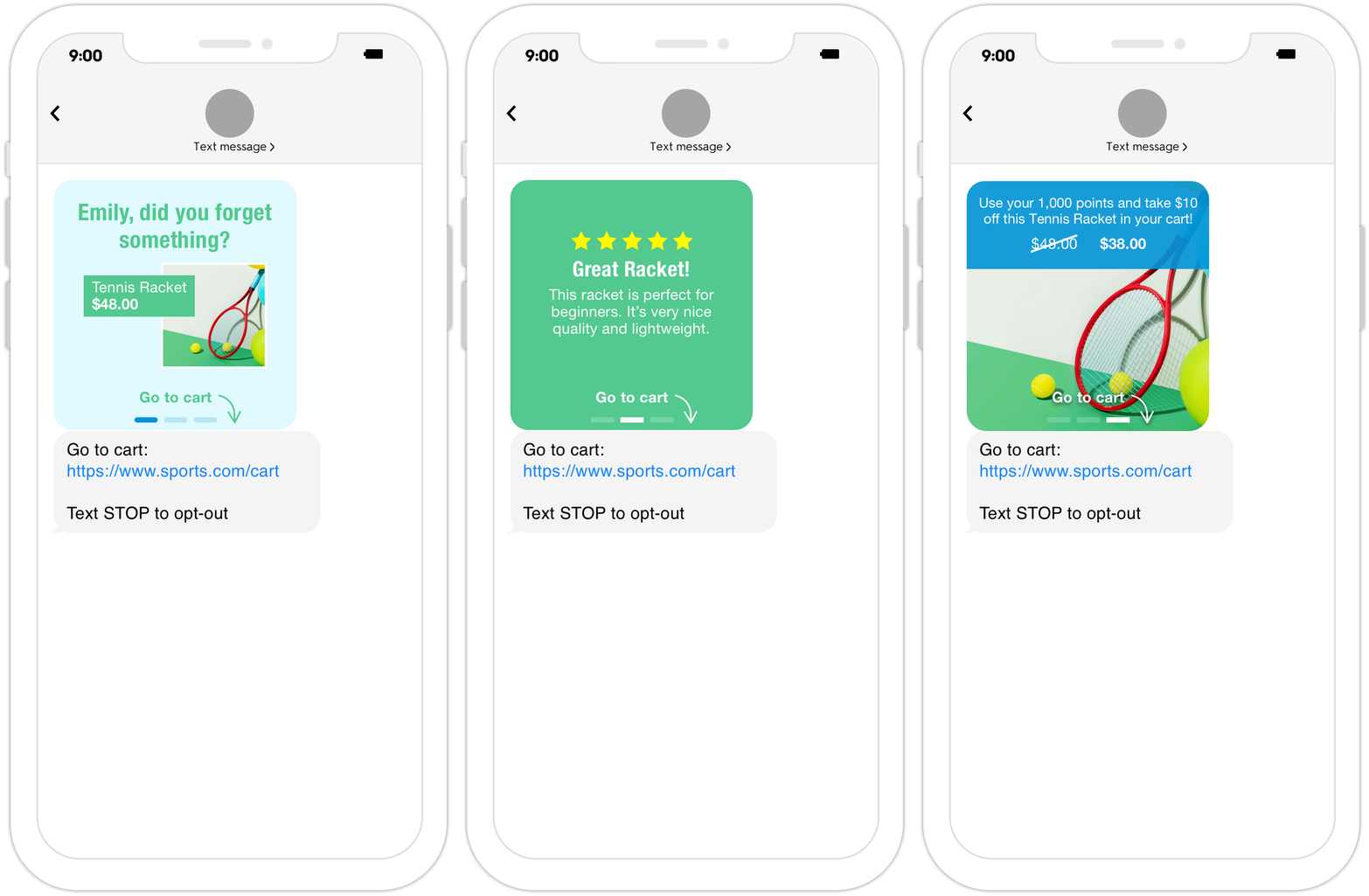
An easy place to start is with an abandoned cart and browse SMS message campaign. These work really well in email, and it’s no different for SMS. In fact, the conversion rates are even better, so you don’t want to miss more opportunities to convert.
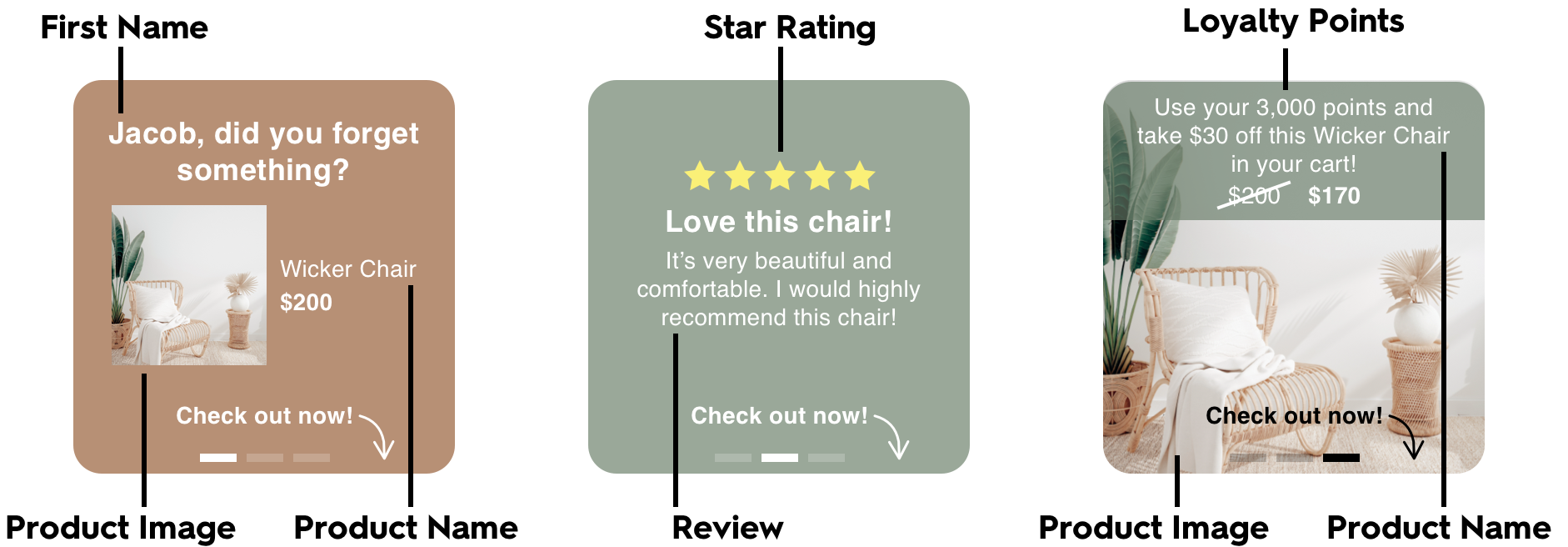
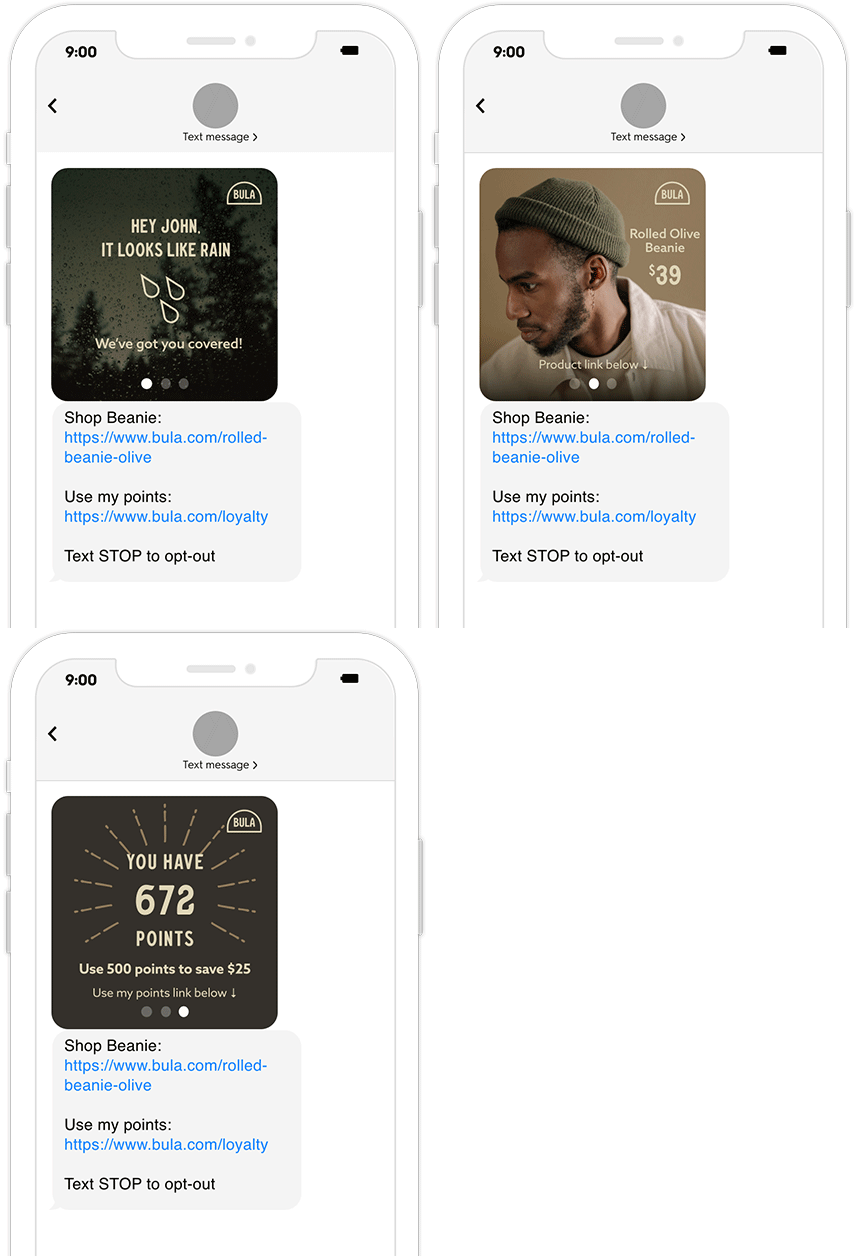
Another way to wow your clients with personalized, animated SMS messages is using geolocation. Consumers respond to weather-based messaging. For example, create a triggered reminder to highlight specific products when the local weather is bad.
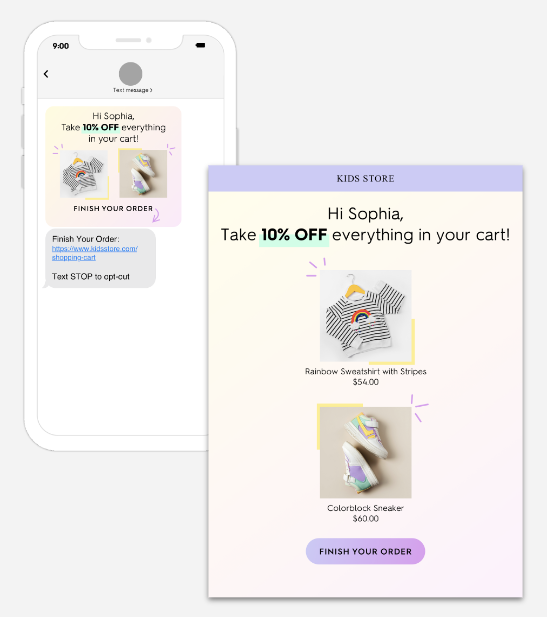
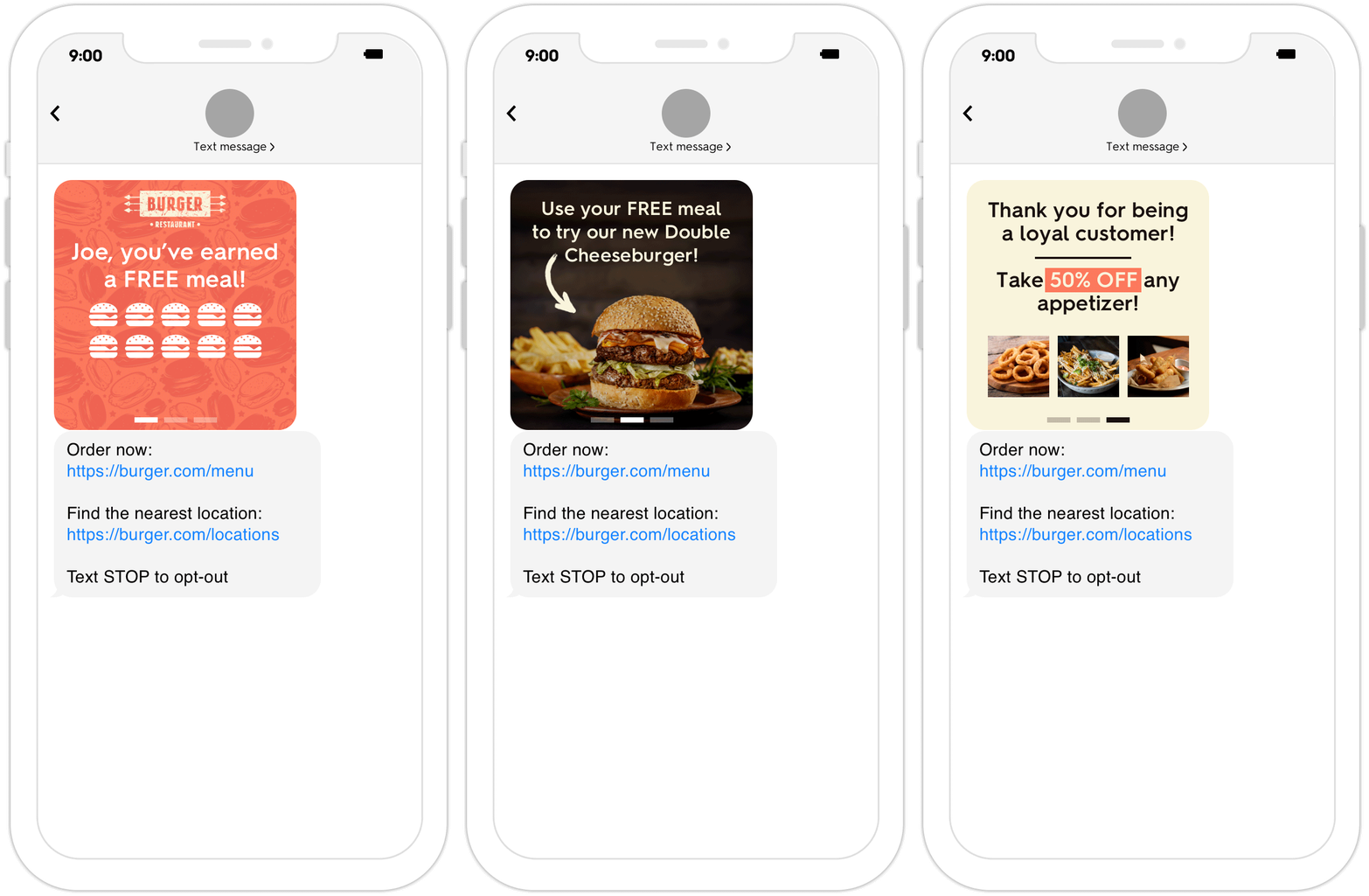
Animation lets you stand out because you can tell a story through dynamic blocks rather than a few static words of text. Grab attention with name personalization, feature product images, and then provide personalized loyalty points — that approach will set you apart.
Make your texts move with Zembula
We love working with brands that take personalization seriously. That goes for both email and SMS marketing. And once you understand the synergy between the two, you’ll take your marketing strategy to new heights.
We’ll show you how to add animation to your personalized SMS messages and really stand out from the competition. And the best part? It’s a lot easier than you think. Our platform automates the process and does all the heavy lifting.
Liz Froment is a content writer at Zembula. A graduate of University of Massachusetts at Amherst, Liz is a travel aficionado, Boston sports fan, and maple syrup connoisseur.
When we first published this list back in 2023, the email personalization market looked different. Most teams were still building out triggered flows and optimizing subject lines. Those things still matter. But the economics around them have shifted hard. Average ecommerce ROAS fell to 2.87 in 2025, with declines across 13 of 14 industries. CAC is up 40 to 60% since 2023. The CFO is asking tougher questions about every channel, including email. And the honest answer is that most email teams still can’t measure content performance at the level paid media teams take for granted. That’s where tools like Smart Banners and block-level attribution start to matter.
The original version of this post treated email personalization tools as roughly interchangeable: compare features, check integrations, pick the one with the best price. That framing missed the bigger question. Most of these tools were built for triggered email, which represents about 5% of total send volume. The remaining 95% (broadcast, promotional, editorial sends) goes out with minimal personalization. Maybe a first-name merge tag. Maybe a men’s/women’s segment. That’s the gap where the real revenue opportunity sits, and it’s the gap that should drive your evaluation.
What Changed Since 2023
Three things reshaped how you should evaluate email personalization tools. First, measurement expectations caught up to email. According to Litmus’s 2025 State of Email report, 21% of marketing leaders still don’t know their actual email ROI, and 63% now face increased CFO scrutiny (up from 52% the year before). Campaign-level reporting is no longer enough. You need to know which content block inside each email is producing revenue, and at what rate.
Second, Apple Mail Privacy Protection made open rates unreliable. Open rates inflated from roughly 22.6% to over 40% across billions of messages with no corresponding change in click behavior. Any tool or strategy that relies on opens as its primary signal is working with noise, not data.
Third, the economics of paid acquisition got worse. Meta CPMs climbed 20% year-over-year, Google CPCs rose nearly 13%, and iOS ATT means only 40 to 60% of conversions are even visible to ad platforms. Email is an owned channel with first-party identity and privacy-durable measurement. It should be evaluated with the same rigor as paid media, because it’s increasingly where the budget is shifting.
What Actually Matters Now: Open-Time Rendering, Block-Level Attribution, Brand Fidelity
Before we get to specific tools, here’s the evaluation lens that should replace the old feature-grid comparison. The three capabilities that separate useful personalization tools from nice-to-have ones:
Open-time rendering means content is assembled at the moment a subscriber opens the email, not when it’s sent. This is the difference between showing an abandoned cart item that’s still in stock versus one that sold out six hours ago. It also means your content can reflect real-time loyalty point balances, shipping updates, and price changes without re-sending.
Block-level attribution means you can measure revenue per mille (RPM) and click-to-conversion (CTC) on each content module inside the email, not just the email as a whole. This is how you know whether your Smart Banners are generating $4.50 RPM while a static hero image is generating $0.80. Campaign-level metrics hide this entirely. If you’re comparing your email program’s performance to industry standards, our 2025 email performance benchmark report breaks down what top-performing Smart Banners actually produce.
Brand fidelity means the personalized content actually looks like your brand. Custom fonts, exact color values, proper spacing. HTML email rendering is notoriously inconsistent across clients. Image-based rendering (like Zembula uses) sidesteps this entirely because what you design is exactly what renders.
1. Bluecore (Now Part of Insider One): Predictive Triggered Messaging for Retail
Bluecore was acquired by Insider One in May 2026, but the core product remains the same: predictive triggered messaging built specifically for retail. Bluecore tracks shopper behavior, predicts purchase intent, and fires personalized messages in response to behavioral events (browse abandonment, price drops, back-in-stock). It’s one of the strongest tools in retail for the triggered use case.
Where it stops: Bluecore is purpose-built for event-driven sends. When a shopper abandons a cart, Bluecore shines. But that’s the triggered 5%. It’s not architected for content-level personalization of broadcast sends, and it doesn’t offer block-level attribution on the promotional emails you’re already sending every day.
2. Jacquard (Formerly Phrasee): AI-Generated Copy, with Honest Limits
Jacquard rebranded from Phrasee in 2024 and focuses on AI-generated language for subject lines, push notifications, and SMS copy. It generates messaging variants, runs experiments, and optimizes for engagement metrics. For teams sending high volume and wanting to systematize copy testing, it’s a real time-saver.
The honest limit: Jacquard optimizes words. It does not personalize content blocks inside the email body or render different visual content per recipient at open time. A great subject line gets the open. But with Apple MPP inflating open rates, the subject line’s measurable impact on actual revenue has gotten harder to prove. Jacquard is useful in its lane. It’s not a substitute for a content-rendering personalization layer.
3. Stylitics: Visual Merchandising and Product Recommendations at Scale
Stylitics brings outfit-based product recommendations to email and on-site experiences. For apparel and lifestyle retailers where “how to wear it” content drives incremental purchases, Stylitics adds genuine value. Its styling AI can generate complete-the-look recommendations that feel editorial rather than algorithmic.
The constraint is rendering. Stylitics outputs HTML-based product cards, which means you inherit all the brand-fidelity challenges of HTML email: inconsistent font rendering across email clients, layout shifts on mobile, and the general fragility of CSS in email. For product recommendation email at scale, the styling content is strong, but the delivery format has limits.
4. Twilio Segment: The Customer Data Layer Everything Else Plugs Into
Twilio Segment is the customer data platform (CDP) that sits underneath your personalization tools. It collects behavioral events, unifies customer profiles, and activates that data into downstream systems. If your email personalization is only as good as your data, Segment is where data quality starts.
What Segment is not: a personalization rendering layer. Segment tells your email tool who the subscriber is and what they did. The email tool still has to decide what content to show and render it at open time. This matters because teams sometimes evaluate CDPs as if they solve personalization end-to-end. They solve the data half. You still need a tool that turns that data into personalized visual content in the inbox. The pairing creates the value, not either tool alone.
5. Zembula: Smart Banners and Open-Time Personalization for the 95% of Broadcast Email
This is where we fit, and we’ll be direct about what makes it different. Smart Banners are open-time personalized image banners that sit at the top of every broadcast email. A single dynamic image URL evaluates 100+ behavioral scenarios at the moment of open and renders the most relevant content: abandoned cart, browse abandonment, loyalty balance, shipment tracking, back-in-stock alerts, BNPL reminders, review requests, and more.
Because Smart Banners render as images (not HTML), your brand fonts, colors, and spacing are pixel-perfect across every email client. And because each banner is a measurable content block, you get RPM and CTC attribution at the module level, not the campaign level. You can compare how your Smart Banners perform against your hero image, your Smart Blocks, or any other element in the email.
The bigger point: the other four tools on this list are each strong in their specific lane (triggers, copy, merchandising, data). None of them ship personalized content into your broadcast volume with block-level measurement. That’s the gap. McKinsey found that brands excelling at personalization generate 40% more revenue from those activities than average competitors. When 95% of your email volume runs without content personalization, even a modest lift across that volume is the largest untapped revenue lever in retail email.
How to Pick: A 4-Question Buyer Checklist
Instead of comparing feature grids, ask these four questions when evaluating any email personalization tool:
1. What data sources does it connect to? A tool that only reads from your ESP’s data has a narrow view of the customer. Look for direct integrations with your CDP, loyalty platform, product catalog, and shipping systems. The more data sources, the more personalization scenarios you can run.
2. How does it measure? Campaign-level metrics (total clicks, total revenue attributed to a send) are table stakes. Block-level attribution (RPM and CTC per content module) is what lets you optimize individual components. If your CFO evaluates paid media with ROAS and CPA, your email program should report with equivalent precision. Check the latest performance benchmarks to understand what good looks like at the block level.
3. Does it work on broadcast email, or only triggered flows? If a tool only fires in response to a behavioral event (cart abandonment, browse, price drop), it covers roughly 5% of your volume. Ask explicitly: can this personalize content inside the promotional emails I already send every day?
4. Does the output match your brand standards? Preview the personalized content in Gmail, Apple Mail, and Outlook. If fonts fall back to Arial, if spacing breaks on mobile, or if colors shift, the personalization is undermining your brand, not strengthening it.
What We’d Reallocate Ad Budget Toward First
If you’re a VP of Growth or CMO looking at declining paid ROAS and climbing CAC, here’s the honest case for moving a slice of ad spend into email personalization. Email operates on a first-party identity graph you already own. Every subscriber is a known user with purchase history, browsing behavior, and loyalty data attached. That same data powers your Meta Custom Audiences and Google Customer Match campaigns, but inside email you don’t pay per impression and you don’t lose 40 to 60% of conversions to signal loss.
The first investment we’d recommend: Smart Banners on your broadcast sends. It’s the highest-volume, lowest-effort deployment (one image URL, added once to your template, personalizes every send going forward). It creates measurable, attributable lift on sends you’re already paying to deliver. And it gives your email team the performance-marketing metrics (RPM, CTC, block-level revenue) that survive a CFO conversation.
Key Takeaways
The 95/5 split matters more than any feature grid. Triggered flows are only about 5% of email volume. The biggest personalization opportunity is in the broadcast sends you’re already doing.
Block-level attribution is the new baseline. Campaign-level metrics can’t tell you which content is working. Smart Banners, Smart Blocks, and Smart Kickers each need their own RPM and CTC measurement.
Open-time rendering beats send-time decisions. Customer data changes between send and open. Loyalty balances update, carts get modified, items sell out. Content should reflect reality at the moment of open.
Brand fidelity is a technical choice, not a design preference. Image-based rendering produces pixel-perfect results across email clients. HTML rendering introduces font and layout inconsistencies that compound across millions of sends.
Each tool on this list solves a real problem, but they solve different problems. Bluecore handles behavioral triggers. Jacquard optimizes copy. Stylitics drives visual merchandising. Segment unifies data. Smart Banners personalize the 95% of broadcast volume the others don’t touch, with the measurement rigor email has been missing.
Liz Froment
Liz Froment is a content writer at Zembula. A graduate of University of Massachusetts at Amherst, Liz is a travel aficionado, Boston sports fan, and maple syrup connoisseur.