
What Is Real-Time Email Personalization? How Smart Banners and Open-Time Architecture Work
Most ‘real-time’ email personalization is actually frozen at send. Here’s how Smart Banners, open-time decisioning, and block-level attribution deliver personalization that stays current, no matter when a customer opens.

Most email programs that say they use “real-time personalization” are actually doing something else. They pull customer data at the moment of send, freeze it into the HTML, and ship it to the inbox. If the customer opens 30 minutes later, the content is probably fine. If they open three days later, the loyalty balance is wrong, the cart has changed, and the promo might have expired. If they open eight days later (and plenty do), the email is showing information that is flatly inaccurate. That is not real-time. That is a snapshot, and Smart Banners, Smart Kickers, and open-time decisioning exist specifically because snapshots break.
The distinction between send-time and open-time personalization is not a marketing nuance. It is an architectural choice that determines whether your personalized content earns revenue or erodes trust. And across Zembula’s platform data (7.295 billion personalized opens), one stat keeps surfacing: more than 10% of email revenue from mature programs comes from opens that happen more than a week after the email was sent. That tail is long, and it is valuable. Send-time personalization treats it as an afterthought. Open-time personalization treats it as the opportunity it is.
Moment of Send vs. Moment of Open: The Distinction That Decides Revenue
Send-time personalization works like a print run. Your ESP queries data sources, populates merge fields, builds the HTML, and sends a static email. Everything in it reflects reality at the moment of send. The customer’s experience depends entirely on how quickly they open.
Open-time personalization flips the architecture. The email contains a lightweight image URL (as small as 2KB) that calls back to a decision engine at the moment of open. That engine checks the customer’s current behavioral state, selects the right content variant, renders the image, and serves it in real time. The difference is when the decision happens, and that “when” changes everything.
Think about what changes between send and open. Loyalty points accumulate. A customer adds (or removes) items from their cart. Inventory runs out. A sale starts or ends. Pricing changes. Weather shifts. With send-time data, every one of those signals arrives stale. With open-time, every one arrives current. As Personyze puts it: “Open-time email personalization lets your email show the right products, content, or promotions at the exact moment the recipient opens it, not at the moment it was sent.”
Why 10%+ of Email Revenue Comes From Opens More Than a Week After Send
Email marketers tend to think of opens as concentrated in the first hour. Some are. But the distribution is wider than most teams realize.
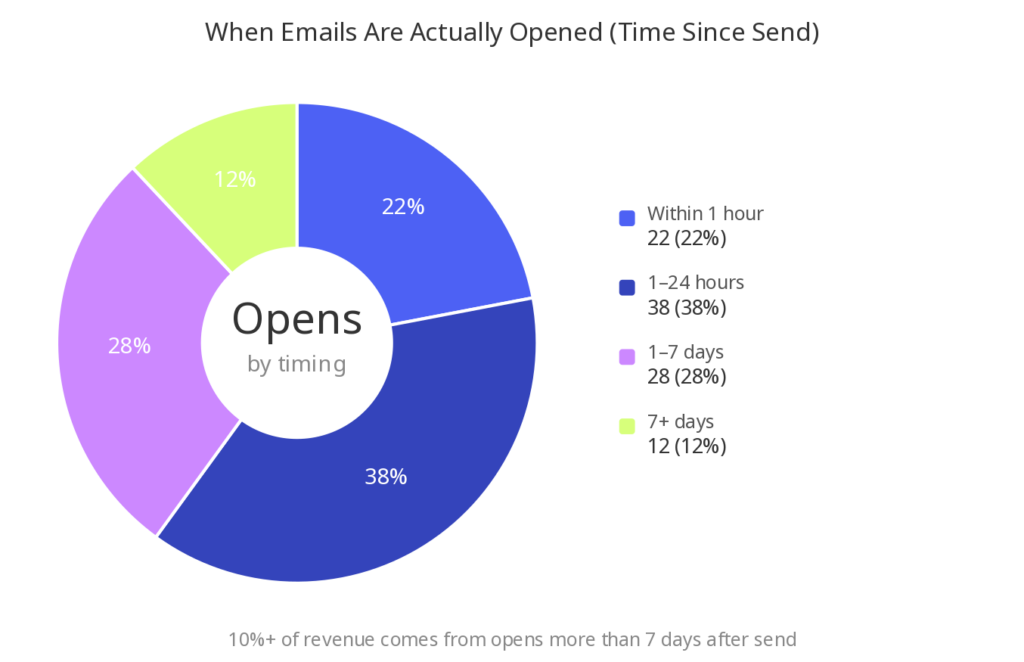
About 22% of opens happen within the first hour, and another 38% land in the 1 to 24 hour window. But a full 28% happen between 1 and 7 days after send, and 12% come after the one-week mark. Those late opens are not low-value stragglers. They disproportionately represent high-intent customers who revisit emails when they are ready to act. And if the content they see is a week old, you lose the conversion.
This is also why Apple’s Mail Privacy Protection (MPP) complicates send-time intelligence so badly. Litmus reports that over 50% of email opens now happen on a device with MPP activated, which means pre-fetching inflates open data and renders send-time optimization signals unreliable. The content decision has to move to the render layer, where the customer’s actual behavior at the actual moment of viewing drives what they see.
What Smart Banners and Open-Time Decisioning Look Like in Practice
At Zembula, open-time personalization takes the form of three modular content blocks: Smart Banners (top of email), Smart Blocks (mid-email), and Smart Kickers (bottom of email). Each is a single dynamic image URL that serves personalized content based on the customer’s state at open.
Here is what happens at the moment of open: the decision engine receives the image request, checks the customer’s real-time data (cart contents, loyalty tier, browse history, location, promotional schedule), runs through a priority-ordered set of content rules, selects the winning variant, renders the image on-the-fly, and returns it. The entire process happens in milliseconds. No template changes are required. No segmentation. One URL, hundreds of possible use cases.
A customer who abandoned a cart yesterday might see their abandoned product with current pricing. A loyalty member 200 points from the next tier sees a progress bar with an accurate balance. If a midnight promotional offer kicks in, emails already sitting in the inbox render the new promotion the next time they are opened. That is what “real-time” actually means.
Smart Banners Across the 95% of Email Volume That Has No Personalization
The conventional wisdom treats real-time personalization as a triggered-flow capability. Abandoned cart, browse abandonment, post-purchase. Those flows matter, but they represent roughly 5% of email volume. The other 95% is broadcast: weekly newsletters, promotional blasts, seasonal campaigns. And in most programs, broadcast email carries zero personalization beyond a first-name merge tag.
That is where Smart Banners change the math. Because a Smart Banner is a single image URL added once to the email template, it can run in every broadcast send without any additional build time. Each customer sees content personalized to their own behavioral context. The marketing team sends one email. The customer sees an email that looks like it was built just for them. This scales personalization from 5% of volume to 100% of volume, and that scale is where the revenue impact compounds.
The industry is slowly arriving at this conclusion from the other direction. Even Braze now publicly states that “an ongoing stream of meaningful, real-time customer data is the fuel” for marketing automation. Salesforce shipped its “Sub-Second Real-Time” open-time capability as a separately purchased Data Cloud product, because the core SFMC batch architecture could not support it natively. Real-time is a different stack. Not a toggle.
Measuring Whether Real-Time Is Actually Working: CTC, RPM, and the End of Open Rates
If you cannot measure the revenue contribution of a specific content block inside an email, you cannot prove that open-time personalization is working. Open rates are noise (half of them are machine-generated). Aggregate click rates tell you the email performed, but not which part of it performed. You need block-level attribution.
Zembula measures two metrics at the individual block, variant, and use-case level: click-to-conversion rate (CTC) and revenue per mille (RPM). CTC tells you what percentage of clicks on a specific block convert into revenue. RPM tells you the revenue generated per thousand impressions of that block. Both metrics operate at the creative-variant level, which gives email the same measurement granularity that paid media teams take for granted.
Across the Zembula platform, Smart Banners average a 13.6% click-to-conversion rate, compared to the 2.5% retail email baseline. That is not a marginal improvement. It is a structural difference that comes from showing a customer content that reflects their actual intent at the actual moment they are engaging. For more context on how these numbers compare to industry norms, see our latest email performance benchmark report.
This kind of block-level observability is what gives email attribution parity with paid ads. When your CFO asks what the return is on email personalization, RPM and CTC give you an answer at the same granularity as ROAS on a Meta campaign, except the audience is owned, the identity is first-party, and the measurement is privacy-durable.
Where to Start: A 10-Week Path From Static Email to Open-Time Personalization
Moving from static to open-time does not require a platform migration or a six-month roadmap. Here is a practical sequence:
Weeks 1 to 3: Instrument one Smart Banner. Add a single Smart Banner to your highest-volume broadcast template. Start with one use case, like abandoned cart content. Connect your cart data feed and publish. No segmentation needed.
Weeks 4 to 6: Layer in additional use cases. Add loyalty balance, browse abandonment, and a default promotional fallback. The priority engine handles selection automatically. One URL, multiple content variants.
Weeks 7 to 8: Add a Smart Kicker. Place a Smart Kicker at the bottom of the same template. Kickers consistently drive outsized click attribution because they catch high-intent readers who scroll through the entire email.
Weeks 9 to 10: Read the data. At this point you have CTC and RPM data at the block level across multiple use cases. You can see which content variants drive revenue and which do not. Expand to additional templates based on what the data tells you.
The point of a phased rollout is to prove the model with real numbers before scaling it. Most teams see measurable revenue contribution within the first billing cycle.
Key Takeaways
- Real-time means open-time. If the data is pulled at send and frozen into the HTML, it is not real-time personalization. It is a snapshot that degrades with every hour that passes before the customer opens.
- Late opens are high-value. More than 10% of email revenue comes from opens that happen 7+ days after send. Send-time personalization treats these as disposable. Open-time personalization treats them as opportunities.
- Smart Banners scale personalization to broadcast. A single dynamic image URL added once to a template brings 1:1 personalization to every email, not just triggered flows. That is the 95% of volume most programs leave untouched.
- Block-level attribution makes email measurable like paid media. CTC and RPM at the variant level give email marketers the same reporting granularity that ad teams have. That is how you justify budget reallocation from paid acquisition to owned-channel performance.
- You do not need a platform migration to start. A single Smart Banner in one broadcast template, connected to one data source, can prove the model in weeks.
Grow your business and total sales