
The Ultimate List of Personalized Email Marketing Statistics
Most lists of personalized email marketing statistics you’ll find online share a common problem: they’re recycled. The same dozen figures get passed from one aggregator blog to the next, stripped of context, date, and primary source along the way. When we published our original version of this post, we were guilty of it too.
This rewrite exists because the email channel has changed fundamentally since those numbers were first published. Apple Mail Privacy Protection added roughly 18 points of fake opens across billions of messages without touching click rates. Retail brands increased send frequency 63% between 2016 and 2024 (from ~95 to ~155 sends per subscriber per year), and real revenue per subscriber fell 35% over the same period when adjusted for inflation using BLS CPI-U data. The stats that once described a thriving channel now describe a version of email that no longer exists. Every stat below includes the year, the primary source, and a link. If a number can’t meet that bar, it’s not on the list.
What consumers expect from personalized email marketing
These are the demand-side numbers. They tell you what your subscribers want, not what most brands deliver.
- 71% of consumers expect companies to deliver personalized interactions, and 76% get frustrated when this doesn’t happen. (McKinsey, Next in Personalization 2021.)
- 91% of brands worldwide now use some form of email personalization. (Contentful, 2025.) This sounds great until you pair it with the next stat.
- Fewer than 20% of retailers have deployed dynamic content in broadcast email, where 95% of their volume lives. The 91% adoption figure masks shallow execution: most brands personalize triggered flows (abandoned cart, welcome series) and leave everything else static.
- 75% of consumers say they are more likely to buy from a company that knows their purchase history and recommends products accordingly. (Instapage / DMA.) Product recommendation emails aren’t optional; they’re expected.
The story these personalized email marketing statistics tell is a gap between what subscribers demand and what brands actually deliver. The expectation for personalization is universal. The execution is concentrated in triggered flows that represent a small fraction of total send volume.
Personalized email marketing statistics: revenue and conversion
These are the numbers that hold up under scrutiny, with current baselines.
- Companies that grow faster drive 40% more of their revenue from personalization than their slower-growing counterparts. (McKinsey, 2021.)
- Good personalization lifts revenues 5 to 15% and increases marketing ROI up to 30%. (McKinsey, 2023.) Note: this is the credible range. You’ll see aggregator sites cite “up to 760%” for segmented campaigns. That figure comes from a single DMA study about segmentation (not personalization), and it describes the extreme upper bound, not a typical result.
- Segmented and personalized email campaigns are responsible for 58% of all email revenue. (DMA / Instapage.) This one holds, but it counts triggered flows. The question is what happens when you apply that same approach to the other 95% of volume.
- Personalized emails produce 6x more transactions than non-personalized emails. (Experian Marketing Services.) Still directionally true, though the gap narrows as basic personalization becomes table stakes.
- Average email campaign click rate across all industries: 1.69%. Top 10%: 3.38%. Average revenue per recipient: $0.32. (Klaviyo, 2026.) These are your current baselines. If your broadcast campaigns are beating $0.32 RPR without dynamic content, you’re already in the top quartile.
For a deeper look at how these numbers connect to the broader case for personalized email marketing, including strategy and ROI frameworks, our full guide breaks it down.
The metrics that broke: opens, the $36 ROI claim, and what to use instead
Some of the most-cited personalized email marketing statistics describe metrics that no longer measure what they used to.
Open rates are broken for comparative analysis. Apple Mail Privacy Protection, which launched in September 2021, pre-fetches email images for all Apple Mail users regardless of whether they read the message. The result: open rates jumped approximately 18 points overnight across billions of messages, with zero corresponding change in click rates. Any stat that relies on open rate comparisons (“personalized subject lines get 26% more opens”) is now measuring noise. We wrote a full breakdown of which email personalization stats still matter and which don’t.
The “$36 ROI” needs context. The widely cited claim that email returns $36 for every $1 spent (from Litmus) is real, but it measures return on ESP subscription cost, not return on subscriber attention or marketing effort. Litmus/Validity’s State of Email 2025 updated this: 70% of companies report email ROI between 10:1 and 36:1. Companies hitting 36:1 to 50:1 dedicate 25 to 50% of their marketing team to email operations. The ROI is real, but it scales with investment, and the bare “$36” figure without that context is misleading.
What to use instead: Click-to-conversion rate (CTC) and revenue per mille (RPM) measured at the block level. These metrics survive Apple MPP because they’re based on clicks and conversions, not opens. They also let you compare individual content modules against each other inside the same email, which campaign-level metrics can’t do.
The 95% problem: broadcast vs. triggered email
Here’s the stat that reframes everything else on this list: 95% of email volume is broadcast. 5% is triggered. Most of the impressive personalized email marketing statistics you see (abandoned cart recovery rates, welcome series revenue, post-purchase flow performance) describe the 5%. The 95% gets a subject line swap and maybe a first-name merge tag.
- Triggered emails generate roughly $2.87 per send. Broadcast emails generate roughly $0.11 per send. That 26x gap is the opportunity. The triggered side is already well-optimized. The broadcast side, where nearly all your volume lives, is barely personalized at all.
- Retail send frequency increased 63% between 2016 and 2024 (from approximately 95 to 155 sends per subscriber per year). Real revenue per subscriber fell 35% over the same period.
- 52% of brands use some form of dynamic content. Fewer than 20% deploy it in broadcast. That 32-point gap between capability and deployment is the single biggest revenue opportunity in email right now.
This is the core argument for broadcast email personalization: the 5% that’s already personalized keeps getting optimized, while the 95% that isn’t keeps getting worse. Flipping that ratio is the highest-leverage move most email programs can make.
Personalization at the block level: CTC, RPM, and what changes with observability
Campaign-level metrics (total revenue, total clicks per send) are like measuring a retail store’s performance by total foot traffic. They tell you something, but they don’t tell you which shelf is working.
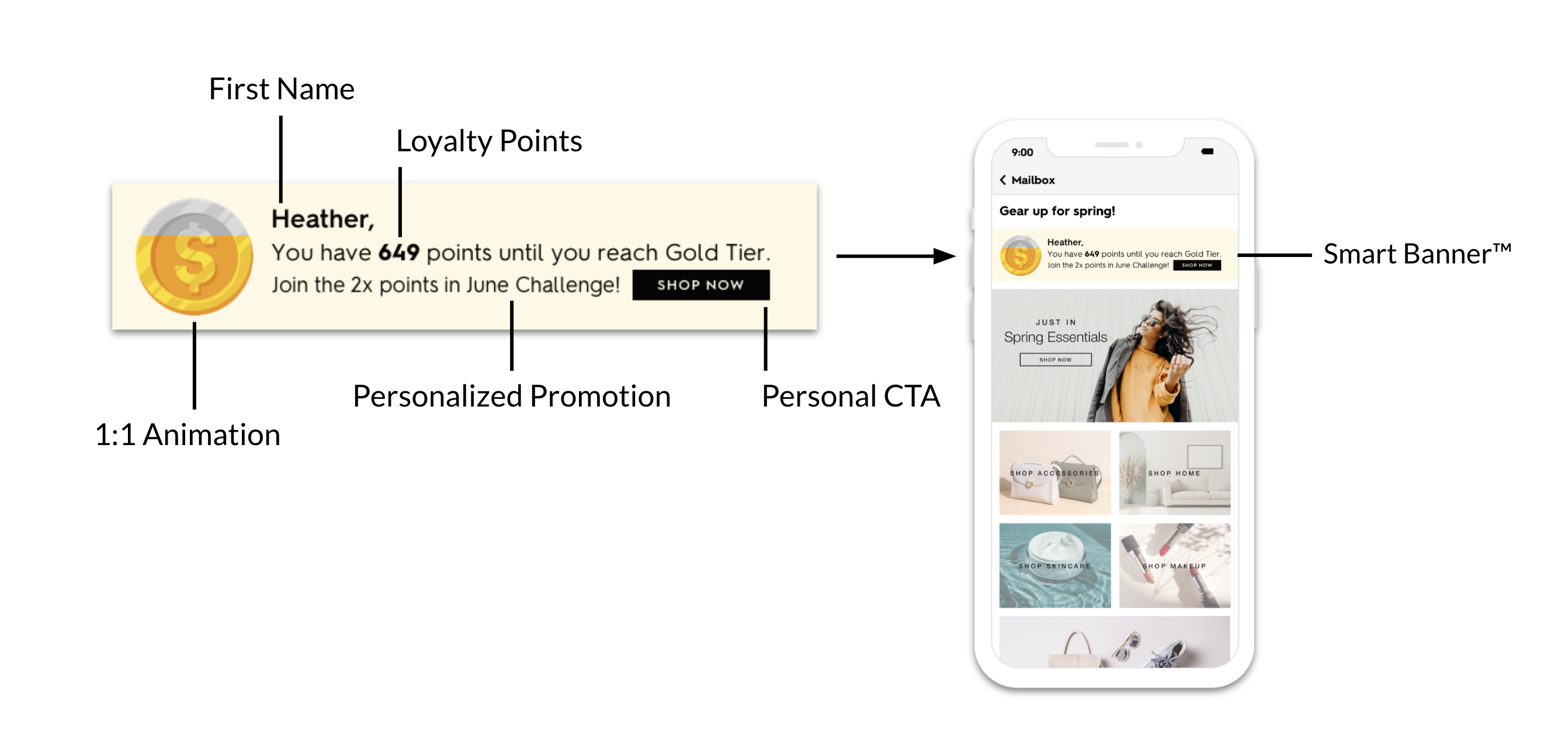
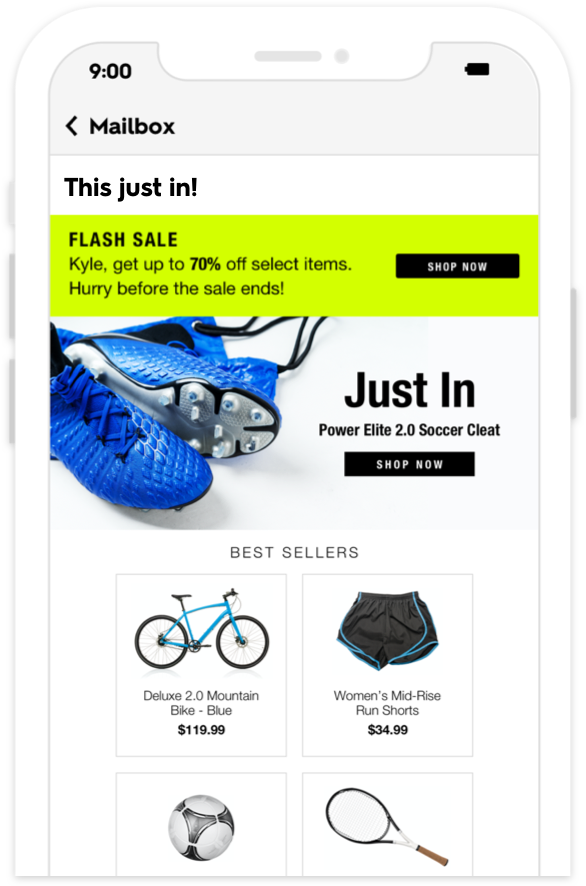
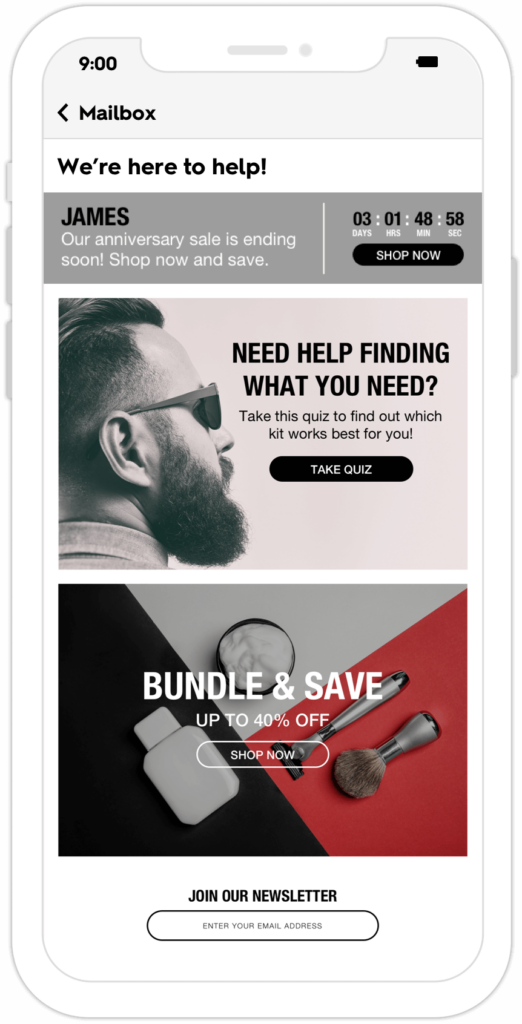
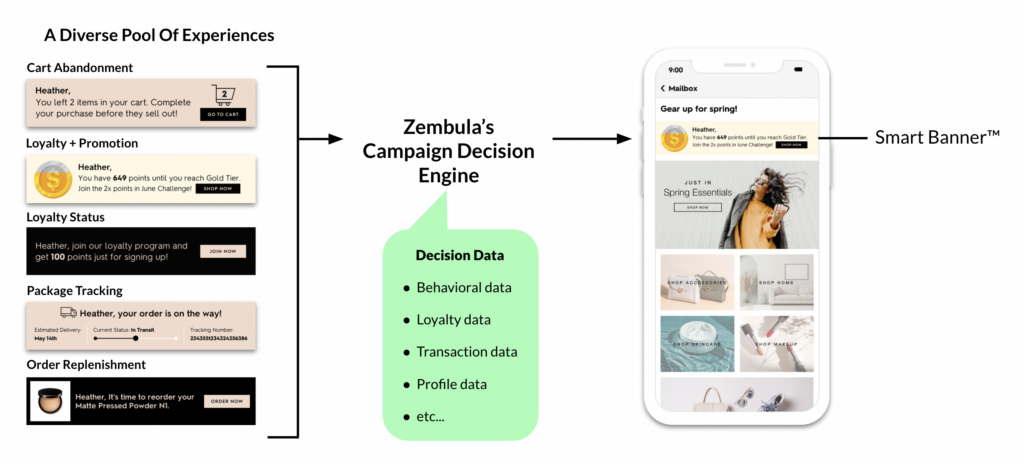
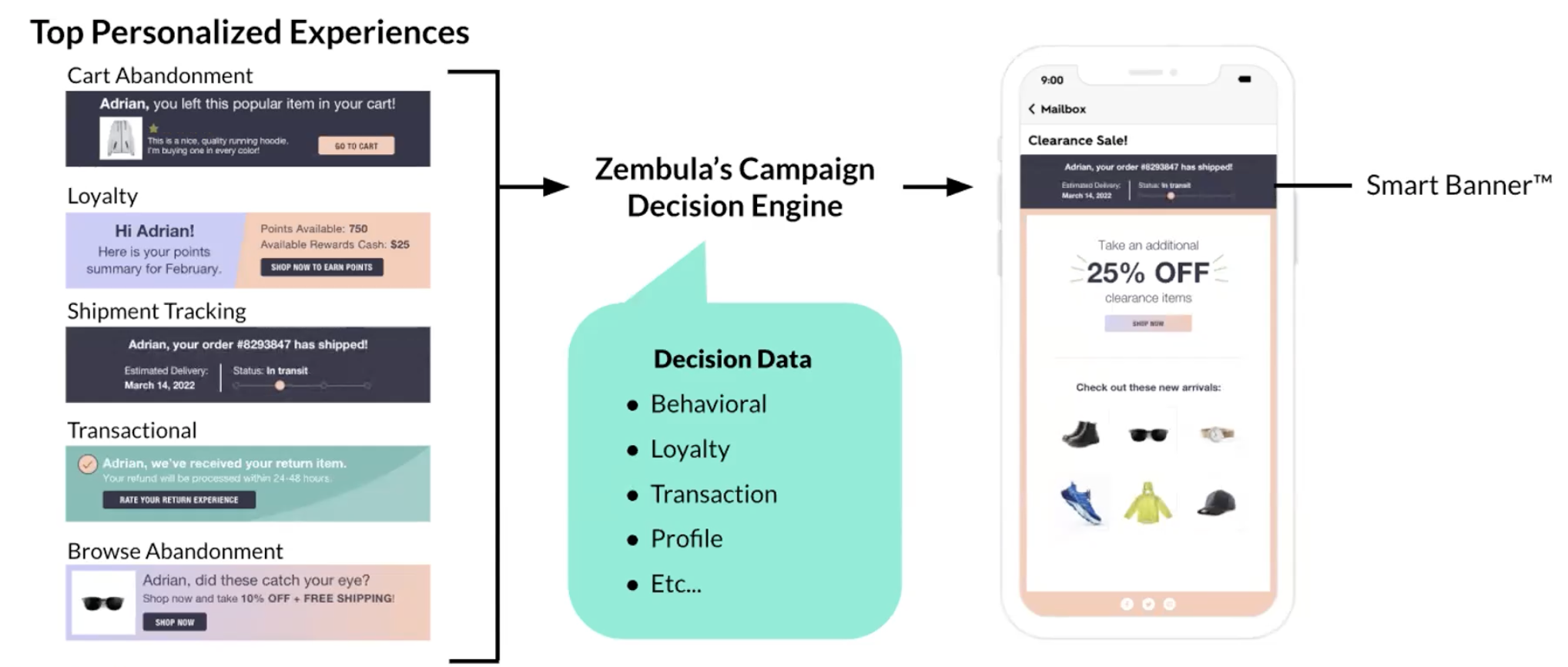
Block-level analytics measure the performance of each content module inside an email: the Smart Banner at the top, the product grid in the middle, the Smart Kicker at the bottom. Each block gets its own CTC (click-to-conversion rate) and RPM (revenue per thousand impressions). This is how email block analytics work in practice.
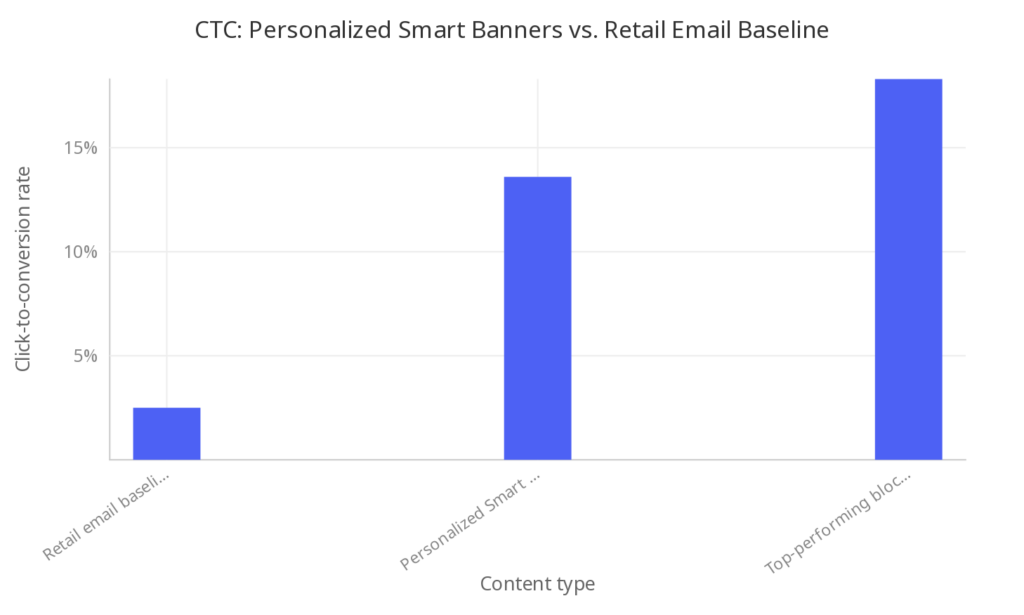
- Personalized Smart Banners average a 13.6% CTC against a 2.5% retail email baseline. That’s a 5.4x improvement, measured at the individual block level. See the comparison in our 2025 email performance benchmark report.
- Top-performing block variants hit 18.3% CTC. These are specific content combinations (abandoned cart + product image + personalized discount) measured per variant, not per campaign.
- More than 10% of email revenue from open-time content comes from emails opened more than 7 days after send. Campaign dashboards stop measuring at send-day. Open-time personalization keeps generating revenue from the long tail, and block-level attribution captures it.
These numbers matter because they give email the same measurement rigor that performance marketing teams expect from paid channels. A CMO can look at CTC by block variant and make the same kind of allocation decision they’d make with ad creative performance data.
Email as a performance channel: stats that put it next to paid ads
This section is for the performance marketing lead or CMO who’s looking at email as a budget allocation decision, not just a CRM tactic. The economics have shifted.
- Average ecommerce ROAS fell to 2.87 in 2025, down across 13 of 14 industries tracked. (Upcounting.)
- Meta CPMs are up 20% year over year. Google CPCs are up 12.88% year over year. (Triple Whale, Search Engine Land.) The cost of reaching the same audience through paid channels keeps rising.
- Ecommerce CAC has increased 40 to 60% since 2023. Shopify merchants saw average CAC rise year over year.
- iOS ATT means only 40 to 60% of conversions are visible to ad platforms. (Ruler Analytics.) You’re optimizing campaigns on partial data. Email, by contrast, runs on first-party identity where 100% of conversions are attributable.
- 71% of publishers now cite first-party data as their key source of positive ad results. The ad industry already runs on email data: Meta Custom Audiences, Google Customer Match, CDP audience syncs. The email list is the foundation that paid channels depend on.
The full case, with the unit economics worked out, is in our post on why email is a performance marketing channel. The short version: email’s marginal cost per send is near zero against an owned audience, its measurement is privacy-durable, and its ROAS at the block level is verifiable in ways that post-ATT ad attribution is not.
Key takeaways
- Cite stats with dates and primary sources. If a personalization stat doesn’t have a year and a named source, treat it as anecdotal. The channel changes too fast for undated claims.
- Stop relying on open rates for personalization comparisons. Apple MPP broke open-rate benchmarks in 2021. Use CTC and RPM instead.
- The “$36 ROI” is real but incomplete. It measures return on platform cost. The range is 10:1 to 36:1 for most companies, and hitting the top end requires real investment in team and tooling (Litmus/Validity, 2025).
- The biggest opportunity is broadcast, not triggered. 95% of your email volume is broadcast. Fewer than 20% of brands personalize it. That gap is where the revenue is.
- Measure at the block level. Smart Banners averaging 13.6% CTC against a 2.5% baseline isn’t a vanity metric. It’s the kind of number a CFO can verify and a performance team can act on.
- Email competes with paid channels on economics. With ad ROAS falling, CPMs rising, and attribution degrading, email’s first-party measurement and near-zero marginal cost make the comparison inevitable.

Grow your business and total sales