

The Ultimate Guide to Personalized Email Marketing Statistics, Strategy, and ROI
The personalized email marketing statistics most brands cite prove that triggered flows work. The problem? Triggered flows are 5% of your volume. This guide reframes the data around broadcast, introduces click-to-conversion as the metric that matters, and maps a five-phase rollout to 1:1 email.

Every email personalization guide published in the last five years follows the same playbook: build better triggered flows. Optimize your abandoned cart. Tune your welcome series. And the personalized email marketing statistics they cite all point the same direction, because triggered flows do convert well. Personalized emails deliver 6x higher transaction rates than non-personalized ones, according to Instapage’s compiled data. Segmented campaigns generate 58% of all email revenue.
Here is the problem with that playbook: every major retailer already runs those flows. They are table stakes. And they represent only 2-5% of total email send volume. The other 95% of your email program, the daily broadcast sends to your full subscriber list, ships with at most two audience segments and zero block-level personalization. That gap between what you’ve personalized and what you haven’t is where the real revenue opportunity sits. McKinsey’s January 2025 research on unlocking the next frontier of personalized marketing found that 71% of consumers expect personalized interactions and 76% get frustrated when they don’t get them. Meanwhile, their earlier research documents 10-15% revenue uplift from personalization done well, with fast-growing companies generating 40% more revenue from it than slower-growing competitors. Applied to broadcast volume, that math compounds to $3-6 per subscriber per year in recoverable revenue.
This guide isn’t another triggered-flow tutorial. It’s a framework for thinking about email personalization where the volume actually is, measured with the personalized email marketing statistics that actually prove ROI.
What Personalized Email Marketing Statistics Actually Measure (and What the Old Definition Gets Wrong)
71% of consumers expect personalized communications. 52% will switch brands when emails aren’t personalized. These numbers get quoted a lot. What they don’t tell you is that the baseline definition of “personalized” has shifted. A first-name merge tag in the subject line was novel in 2016. It’s invisible now. Two audience segments (men/women, active/lapsed) are expected, not differentiated.
What changed is the environment around personalization. The inbox is more crowded: 376 billion emails sent daily in 2025, up from 206 billion in 2015. Apple Mail Privacy Protection invalidated open rates as a trust signal by pre-fetching images for a large share of iOS subscribers, inflating open rates roughly 18 percentage points. And paid-ad CAC inflation is redirecting budget scrutiny toward owned channels. Shopify merchants saw acquisition costs rise sharply in a single year. When average ecommerce ROAS falls to 2.87 across 13 of 14 industries, the CMO starts asking where incremental budget should go.
The personalized email marketing statistics that matter now are the ones tied to revenue impact per content block, not per campaign. That’s a different conversation entirely.
The 95% Problem: Why All Your Personalization Lives in the 5% of Email That Already Works
Triggered flows (abandoned cart, welcome series, post-purchase) represent 2-5% of total retail email volume but generate roughly 37% of email revenue. The per-send value gap is staggering: $2.87 per triggered send vs. $0.11 per broadcast send. Welcome emails alone generate 320% more revenue per message than standard promotional sends.
Those numbers sound like an argument to invest more in triggered flows. They are the opposite. They prove the case for personalizing broadcast.
Every retailer already runs triggered flows. They are optimized, staffed, and delivering. The marginal improvement from further optimization is small. But the 95% of volume that is broadcast operates at $0.11 per send precisely because it ships with no content personalization. That’s a structural problem, not a creative one.
Here’s the volume trap: since 2016, sends per subscriber per year have risen from 95 to 155 (a 63% increase), while real inflation-adjusted revenue per subscriber has fallen from a peak of $51 in 2018 to $33 in 2024. More sends, less value per subscriber. The industry response has been to send even more, which accelerates the per-subscriber economics in the wrong direction.
McKinsey’s documented 10-15% personalization revenue uplift, applied to that broadcast volume, is worth $3-6 per subscriber per year. For a retailer with 1 million subscribers, that’s $3-6 million annually. Enough to reverse that 35% real per-subscriber decline. The path there isn’t more triggered flows. It’s block-level personalization across the sends you already make.
Stop Measuring Opens. Start Measuring Click-to-Conversion.
The two metrics email teams have relied on for years are both broken, for different reasons.
Open rates are inflated by Apple MPP, which pre-opens emails for a significant share of iOS subscribers. An 18-point artificial inflation means the number doesn’t represent human engagement anymore. It represents server behavior. That inflation hasn’t normalized, and it won’t.
Click rates tell you which subject line won the inbox, not which content drove purchases. A high click rate on a promotional email with no conversions is a failure dressed up as a win.
The metric that proves email content actually works is click-to-conversion (CTC): what percentage of email clicks convert to purchases. It strips out all the upstream noise (deliverability, subject lines, send time) and isolates the question that matters: did the content in this email cause someone to buy?
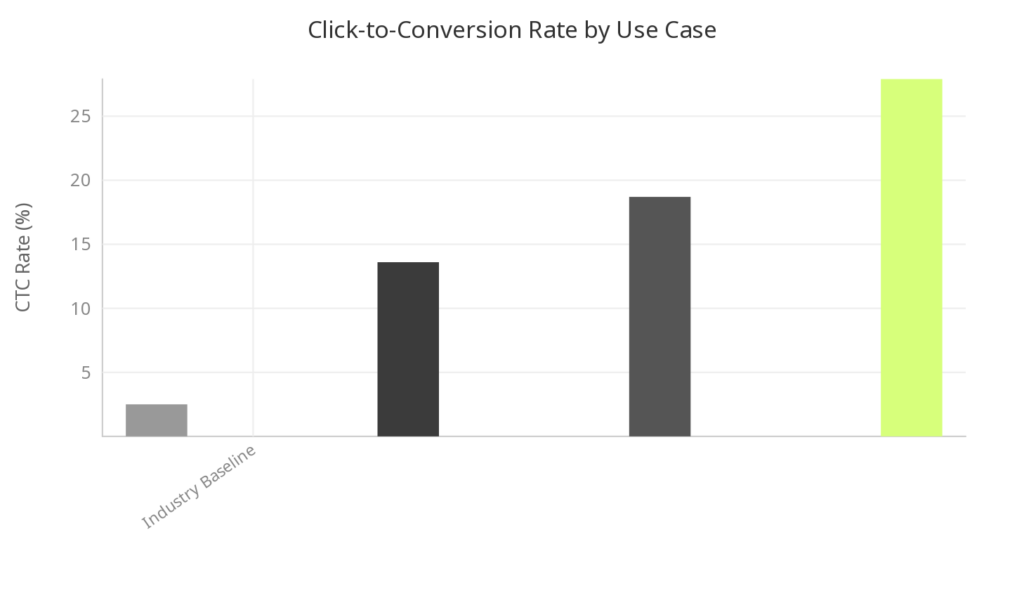
Industry baseline CTC for retail broadcast email is roughly 2.5%. Personalized Smart Banner and Smart Kicker content on Zembula’s platform averages 13.6% CTC, a 5.4x improvement over baseline. Multi-signal combinations push further: Cart + Loyalty + Price Drop hits 18.7% CTC. Cart + Coupon + Countdown reaches 27.9%. (You can see the full breakdown in our 2026 email performance benchmark report.)
CTC also unlocks RPM (revenue per thousand impressions), the email-side analog to paid-media ROAS. A $50+ RPM on a Smart Banner is a structurally better return on the impression than a 2.87x ad ROAS at current CPM levels. When your CFO asks you to compare email investment to ad spend, CTC and RPM are the numbers that translate. Block-level attribution makes this measurable at the content module level, not just the campaign level.
Four Generations of Email Personalization, and the Rendering Layer Most Brands Ignore
There are four generations of email personalization, and most brands are stuck between the first two.
Generation 1: Name tokens and segment copy. First name in the subject line, two or three audience segments, maybe a loyalty tier mention. Still useful. No longer differentiating. Every ESP supports this natively.
Generation 2: Behavioral triggers. Abandoned cart, browse abandonment, post-purchase, welcome. High CTC, but limited to the 5% of volume where the trigger event occurred. This is where every “email personalization best practices” article stops.
Generation 3: Open-time dynamic content. Content that renders at the moment of open, not at send time. A loyalty email opened three weeks after send still shows the current balance. An abandoned cart banner appears in a broadcast email even if the subscriber’s cart was empty when the email was sent, because the cart state is resolved at open. More than 10% of email revenue comes from emails opened 7+ days after send. Send-time personalization misses all of it.
Generation 4: Image-based personalization. The same behavioral data rendered as a composed image rather than HTML. Brand fonts, not system fonts. Art-directed product photography with text layered over extended backgrounds. The same personalization logic, delivered as an image instead of an HTML block, drives 5-7% more conversions. That’s not a design preference. It’s a rendering architecture difference. HTML email can’t render brand fonts, can’t layer text over images reliably, and breaks layout across clients. Those constraints directly suppress conversion on personalized blocks.
There’s also a related issue that rarely gets discussed: banner blindness. Static content placed in predictable screen positions is ignored. This is well-established UX research, not an opinion. It means even a perfectly designed static banner underperforms a block that varies per subscriber. Small per-person variation in layout, messaging, and use case defeats pattern recognition and keeps the eye on the content. The Campaign Decision Engine handles this by auto-selecting the right use case per subscriber per open across 100+ behavioral scenarios, so no two opens see the same content unless the data warrants it.
Product Recommendation Emails: Why HTML Cards Underperform On-Brand Images
HTML product recommendation emails have been the standard for years. System fonts instead of brand fonts. Raw PDP images pulled from the DAM without art direction. Layouts constrained by what Outlook and Gmail will render consistently. Spacing and visual hierarchy that never quite match the rest of the email template.
These aren’t aesthetic complaints. They suppress conversion. The same product recommendation email rendered as a composed image (brand fonts, layered pricing callouts, urgency timers, star ratings designed to brand spec) converts measurably better. The image approach also sidesteps Gmail’s 102KB clipping limit, a hard constraint for programs that stack HTML blocks.
The test protocol for replacing HTML product cards with image-based ones is straightforward. Step 1: replicate the existing HTML card as a Zembula image, straight replica, nothing added. Step 2: build the on-brand version with brand fonts, designed layouts, and pricing treatments. Step 3: run both as a controlled A/B test with subscriber assignment locked at first open and held constant across subsequent sends, so you isolate the rendering variable from novelty effects and cadence-dependent performance swings.
The Five-Phase Rollout: From Smart Banners to Fully Personalized Broadcasts
Personalizing 95% of your email volume sounds like a multi-year infrastructure project. It doesn’t have to be.
Phase 1: Smart Banners + Smart Kickers in every broadcast email. Ten-week launch timeline. Weeks 1-2: connect data feeds (roughly 30 minutes of IT time). Weeks 3-4: design and configure use cases. Week 5: UAT via preview link and one ESP test send. Week 6: go live across 100% of broadcast. Weeks 7-10: accumulate data. The Campaign Decision Engine auto-selects the right use case per subscriber at open across 100+ behavioral scenarios. Zero daily workflow changes.
Phase 2: Personalized hero images in triggered emails. Cart, browse, post-purchase. The triggered flows already convert well. Image-based personalization makes them convert better.
Phase 3: Image-based product grids replacing HTML cards. This is where the product recommendation email upgrade happens, using the test protocol described above.
Phase 4: Category banners personalized to shopping affinity. Each subscriber sees the product category most aligned with their browsing and purchase history.
Phase 5: Personalized broadcast hero. Subject line, hero title, and hero imagery all coordinated per audience cohort. The most complex capability, but it builds on all the infrastructure from Phases 1-4. At this stage, the program runs as three coordinated teams: Editorial (brand narrative and guardrails), Data (template library and signal logic), and Performance Marketing (block-level dials). Designers shift from production execution to systems thinking, defining the rules instead of building individual emails.
Advancement criteria: 4+ weeks of positive RPM lift at Phase 1 before moving to Phase 2. Each phase builds compounding infrastructure. Rushing to Phase 3 without Phase 1 data means you’re guessing instead of measuring.
How to Prove Personalized Email Marketing Statistics and ROI to a CMO Who Thinks in Paid-Media Terms
This is the budget conversation the email marketer needs to win internally, and the audience for it isn’t your email team. It’s the CMO or VP Growth who sits above both the ad team and the email team.
Start with context that person already knows: average ecommerce ROAS fell to 2.87 across 13 of 14 industries. Meta CPMs are up 20% YoY. Google CPCs rose 12.88% YoY (Search Engine Land). CAC is up 40-60% since 2023. iOS ATT means only 40-60% of conversions are even visible to ad platforms (Ruler Analytics). The economic buyer funding both teams is already asking where incremental performance budget should go.
Email’s documented ROI of $36-40 per dollar dwarfs paid media’s roughly $2.50. But that’s a channel-level number. What the CMO wants is creative-level performance data, the same granularity they get from ad platforms. Module-level RPM on personalized content is the email analog to ad-platform ROAS at the creative level. A $50+ RPM on a Smart Banner, measured across millions of impressions with 7-day click-based attribution, is a structurally superior return vs. a 2.87x ad ROAS at current CPM levels. Across 7.295 billion personalized opens, the Zembula platform delivers an average 49.48x ROAS. See the full numbers in our 2026 email performance benchmark report.
The pitch that lands: reallocate one percentage point of ad spend. That’s a rounding error to the ad team and a 5-10% capacity increase to the email program. The math works because email runs on an owned audience with first-party identity and privacy-durable measurement. You’re not buying attention. You already have it.
The pilot framing: 10 weeks, roughly 6 hours of total IT effort, zero daily workflow changes after Week 6. That’s a testable, low-risk proposal with a clear measurement framework.
One more thing worth noting: Zembula’s image-rendering layer is channel-agnostic. The same composed image that powers a Smart Banner in email plugs into RCS rich cards and MMS. So the broadcast personalization playbook you build here ports to rich messaging without a new tech stack.
Key takeaways
- Triggered flows are table stakes. Every retailer runs them. They are 5% of volume and no longer a growth differentiator. The real personalized email marketing statistics opportunity is in broadcast.
- 95% of email volume ships with zero content-level personalization. That gap is worth $3-6 per subscriber per year, per McKinsey’s documented 10-15% personalization uplift.
- Open rates are broken. Apple MPP inflates them roughly 18 points. Click-to-conversion (CTC) is the metric that proves content ROI and translates to paid-media comparisons.
- Image-based personalization outperforms HTML. The same data rendered as a composed image vs. an HTML block drives 5-7% more conversions. Product recommendation emails are the highest-impact test case.
- Smart Banners average 13.6% CTC vs. a 2.5% broadcast baseline, a 5.4x improvement. Multi-signal combinations reach 27.9%.
- Start with broadcast, not triggered. Broadcast reaches 100% of subscribers, accumulates data faster, and the absolute revenue potential is far larger than optimizing flows that already perform.
- The pilot is 10 weeks. Roughly 6 hours of IT time. Zero daily workflow changes. That’s a conversation any CMO should want to have.
Grow your business and total sales