

How RCS Business Messaging Transforms Retail Communication
RCS business messaging hands retail verified sender, rich cards, carousels, and read receipts. Here is what each one structurally earns per message, and how Smart Banners turn a verified rich card into measurable owned-channel revenue.

Every owned channel is the same bet measured a different way. You pay to reach an audience you already earned, then you count what each message returns. Judged that way, RCS business messaging stopped being a science project in late 2024, and the retail teams still treating it like a slightly richer text message are missing the part that actually pays: the creative inside the card. That creative layer, the open-time personalized image we build as Smart Banners, is what turns a verified rich card from a prettier notification into a measurable revenue line.
The timing is not subtle. Apple shipped RCS support to the iPhone in iOS 18 on September 16, 2024, and RCS Business Messaging went live across Apple devices on October 28, 2024. In one quarter, RCS moved from an Android feature to a near-universal mobile inbox. Citing Juniper Research, Digital Virgo ties a +500% surge in global RCS business messaging revenue to that Apple adoption, with roughly 50 billion RCS business messages sent worldwide in 2025. This is not a channel you are early to. It is a channel your competitors are already funding.
So this is not another “RCS is coming” piece. We have already made the owned-channel investment case, written the MMS versus RCS performance framework, and walked through the broad ROI data elsewhere. This post does the narrower, more useful job: a plain walkthrough of what verified sender, rich cards, carousels, and read receipts each structurally deliver for retail, where Smart Banners render inside them, and why the metric most teams reach for first is the one that will mislead them.
Why RCS Went Operational in 2024, Not 2026
The reason 2025 became RCS’s first real year is the Apple inbox. Before iOS 18, business RCS reached only Android, which capped its value for any retailer with a mixed audience. After October 28, 2024, a single rich card could land on nearly every phone in your file. That is the moment the channel became fundable for a CRM team, because you could finally model coverage instead of guessing at it.
The deployment numbers back that up. Sinch’s 2025 State of RCS, a survey of more than 1,600 business leaders, found 26% of retailers already using RCS and another 35% planning to invest, with RCS usage growing 111% over Black Friday and Cyber Monday 2024 versus 2023. On the supply side, Infobip reports North American RCS traffic on its platform grew roughly 70x in 2025 and global RCS traffic climbed 311% year over year. That is peer-set deployment during your highest-revenue weeks, not a pilot somebody is sitting on.
What Verified Sender, Rich Cards, and Read Receipts Actually Do
The plumbing matters here, so let me define it the way Google’s RCS Business Messaging spec does. RCS gives a brand three things SMS and MMS structurally cannot.
Verified sender. Your message arrives under a registered brand profile: your name, your logo, your brand color, and a verification checkmark in the header. The recipient sees a known company, not a random 10-digit number or short code. Sinch reports 80% of consumers trust verified senders more, and that trust is doing more work than most teams realize, which we will get to.
Rich cards and carousels. Instead of a 1,600-character text and a stripped image, you get image-led cards, swipeable carousels, and tappable suggested actions. A rich card can show a product, a price, and a buy button in one frame. A carousel can show a personalized set of three to ten products the recipient is most likely to want.
Read receipts and analytics. RCS reports delivery and read events back to the sender. You know what landed and what got opened, which is the kind of measurement email teams have had for years and SMS never really gave you.
None of those three exist on MMS. That gap is the whole argument, and it shows up in the numbers in a way that is easy to misread.
The Retail Performance Picture, and How Wide the Range Really Is
Let me be honest about the published data before anyone quotes the splashiest figure. The range is wide and the sources do not agree, so treat the high end as an upper bound, not an average. Infobip reports RCS open rates around 72% and click-through rates of 15-30%, with up to 51% in exceptional campaigns. Sinch puts RCS click-through at 3-7x higher than Rich SMS. CM.com reports RCS conversion rates of 20-40%, and 50-80% in strong cases, against SMS near 3-5% and email under 2%.
A 20-40% conversion claim with a 50-80% ceiling should make any performance marketer squint. Some of that is selection bias (early RCS campaigns go to your most engaged buyers), some is creative quality, and some is just small samples reported by vendors with skin in the game. The useful move is to anchor RCS against numbers you already own. If you want the email side of that comparison done rigorously, our 2025 email performance benchmark report lays out the click-to-conversion and revenue-per-mille baselines your program should be measuring RCS against.
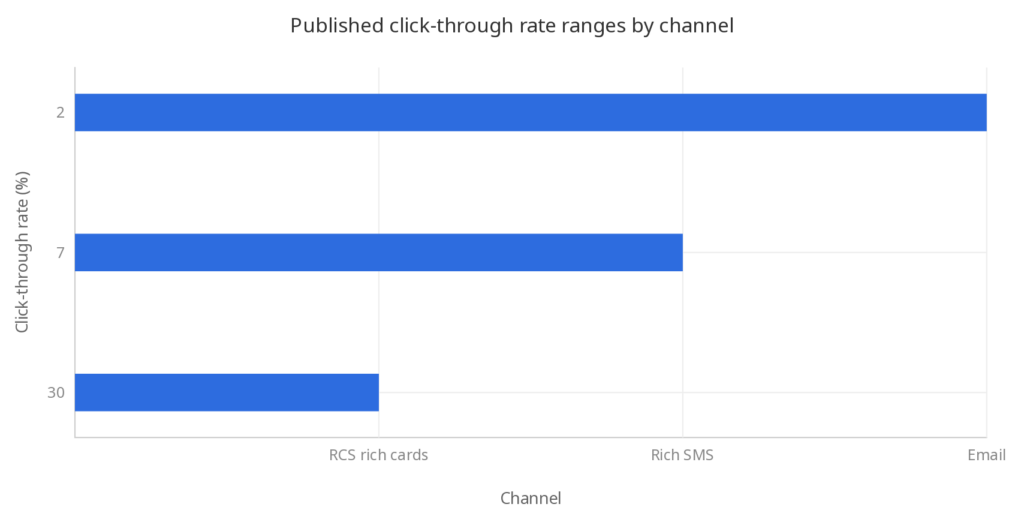
Those bars are published ranges from the sources above, not Zembula data, and the click figures carry a quiet asterisk that almost nobody prints next to them. That asterisk is the most important thing in this post.
Measure Smart Banners and RCS Like Email, Not Like SMS
Here is the counter-intuitive finding. In plenty of retail tests, RCS posts a lower raw click rate than SMS. Teams see that and conclude RCS is underperforming. They have it backwards.
SMS click counts are inflated by machines: link-checking bots, carrier security scanners, and preview crawlers that fire on every URL whether a human is behind it or not. RCS strips most of that out. So when your RCS click number deflates, what you are usually seeing is the bot traffic leaving, not the buyers. The denominator got cleaner. The signal got better.
The fix is to stop grading RCS on the SMS scorecard. Measure it like email. Placed-order rate and revenue per recipient are the metrics that prove RCS, and they map one-to-one to the click-to-conversion (CTC) and revenue-per-mille (RPM) numbers your email team already lives by. This is the same point we make in our argument that email is a performance marketing channel: the proof is downstream revenue, not the vanity click. Smart Banners carry that same attribution model into rich messaging, so a card’s revenue per recipient is comparable to the email block it came from, on the same 7-day click-based window.
Verified Identity Drives the Lift, Not Richer Media
The second underreported finding rearranges the priority list. Most coverage assumes the carousel and the buy button are what lift RCS. The cleaner tests say otherwise.
Infobip ran A/B tests holding the images, text, and links identical, changing only the channel, and RCS rich cards converted 60-70% higher than MMS. Same creative. The only variable was that one message arrived from a verified brand profile and the other from an unknown short code. Vibes reports its customers see a 3x lift in engagement and 30% more revenue versus comparable SMS and MMS, and notes that even a simple RCS message (plain text with a suggested reply) beats MMS for the same reason. And in Google’s own case study, Brazilian retailer Casas Bahia generated 6.2x higher ROI and 1.6x more conversions with RCS versus other conversational channels.
The takeaway is practical. Verification is the floor, not the ceiling. Even your most basic verified RCS message should beat MMS, which means you do not need a perfect rich-media program on day one to see lift. You need to be verified, then you let the creative compound the advantage.
Where Smart Banners Fit Inside RCS Rich Cards
Let me be direct about what we do and do not do. Zembula does not send RCS, and that is the point. The delivery platforms (Sinch, Infobip, Twilio, Bird) handle registration, routing, and the verified profile. We are the image layer that makes the rich card worth the impression.
A Smart Banner is a single image URL rendered at the moment the message is opened. The same URL drops into an email block, an RCS rich card, or an MMS, with no separate build per channel. Because the content is chosen at open time, the card reflects what is true right now: the item still sitting in the cart, the loyalty tier, the hours left on a promotion. Cart, loyalty, and urgency signals stack inside one image instead of forcing you to maintain a dozen static variants. Smart Kickers do the same job in a thinner strip above the fold. If you want the full mechanics, the ultimate guide to Smart Banners covers how the open-time render works under the hood.
This is why the image layer ports so cleanly. The rich card is the new frame. The personalized picture inside it is the thing you already know how to produce.
How to Stage Smart Banners Into Your Owned-Channel Mix
You do not rebuild a program to add RCS. You translate the one you have. The modular performance playbook email teams spent a decade building (open-time rendering, multi-signal personalization, block-level attribution) is exactly the playbook RCS rewards.
Practically, that means three moves. Port your existing Smart Banners into a rich card by pointing the sender at the same render endpoint. Keep your block-level RPM and CTC attribution so a card’s revenue is comparable to its email twin. And measure the pilot on placed-order rate and revenue per recipient, not raw clicks. Run one or two RCS pilots a quarter as a halo to the email program, with email staying your primary owned channel. The MMS versus RCS framework is a good companion if you are deciding which campaigns to promote from MMS first.
The brands that win in 2026 will not be the ones who “tried RCS.” They will be the ones who ran the email-to-rich-card translation first and owned the performance gap before it closed.
Key Takeaways
- RCS is operational, not speculative. iOS 18 brought RCS to the iPhone in September 2024, business messaging went live on Apple devices that October, and 26% of retailers already use it per Sinch.
- Verified sender, rich cards, and read receipts are the structural difference. SMS and MMS cannot do any of the three.
- Lower RCS clicks can mean it is working. RCS strips bot traffic that inflates SMS click counts, so measure placed-order rate and revenue per recipient instead.
- Verified identity drives most of the lift. Infobip saw 60-70% higher conversion than MMS with identical creative, purely from the verified profile.
- Smart Banners are the image layer, not the sender. One open-time render endpoint feeds email, RCS, and MMS, while Sinch, Infobip, Twilio, or Bird handle delivery.
- Translate, do not rebuild. Port your modular email attribution and personalization into rich cards, run one to two pilots a quarter, and keep email primary.
Grow your business and total sales